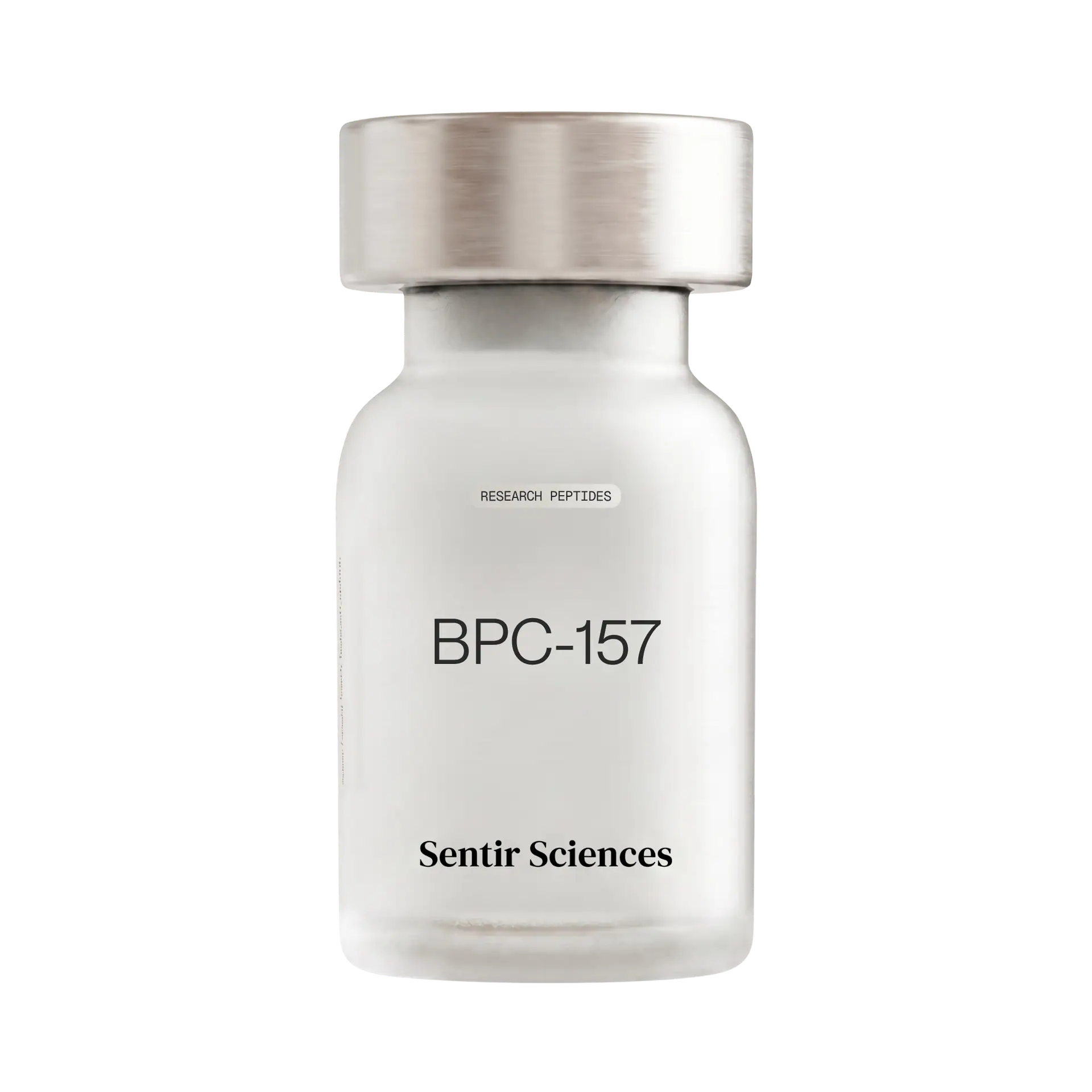
BPC-157, mapped honestly.
The most-searched peptide in recovery research is also one of the most mythologized. This is the literature as it stands — what's studied, what's proposed, and what remains genuinely unknown.
Where BPC-157 came from.
In the early 1990s, researchers in Zagreb studying why the stomach doesn't digest itself isolated a protective protein from human gastric juice, which they named Body Protection Compound. BPC-157 is a synthetic fifteen-amino-acid fragment of it — the piece identified as carrying the activity. Its gastric origin left it an unusual signature: unlike nearly every other peptide, it remains stable in stomach acid, the environment it evolved in.
Three decades later, the compound has accumulated one of the largest preclinical literatures of any research peptide — a body of work that is broad, largely positive, and carries a caveat worth stating up front: a substantial share of it originates from the same Croatian research lineage that discovered the molecule. That doesn't invalidate the findings; it does mean independent replication is thinner than the citation count suggests, and honest readers hold both facts at once.
The three model families that dominate the literature.
Musculoskeletal repair is the best-known thread: studies of transected tendons, ligament injury, muscle crush and tendon-to-bone healing in rodents, plus cell-level work showing enhanced fibroblast outgrowth. The gastrointestinal thread is the compound's original home — protection and healing across lesion models of the whole digestive tract, from esophagus to colon, including inflammatory-bowel models. The third thread is vascular: BPC-157 consistently behaves as a modulator of blood-vessel response in injury models, which many researchers suspect underlies the other two.
Proposed mechanisms — plural, and still open.
- Angiogenesis: reported upregulation of VEGFR2 signalling and promotion of new vessel formation in ischemic tissue — the leading candidate for a unifying mechanism.
- The nitric-oxide system: extensive work reports interaction with NO synthesis pathways, tying into blood-pressure and vascular-tone findings.
- Growth-factor crosstalk: reported influence on growth-hormone receptor expression in fibroblasts, connecting it loosely to repair signalling at the cell level.
- Cytoprotection: the original framing — a general stabilizing effect on cells under stress, consistent with its gastric-defence origin.
No single mechanism is settled, and the honest summary is that BPC-157 is a well-documented phenomenon still waiting for a fully characterized pathway — part of why it remains actively studied rather than a closed chapter.
What the literature is not.
It is not human evidence. The published record is overwhelmingly rodent models and cell culture; controlled human data is essentially absent, which is precisely why BPC-157 remains a research compound and why we sell it under research-use-only terms with no outcome claims. Anyone summarizing this molecule without that sentence is selling something other than information.
Reading the research yourself.
The literature is indexed and public. Searching PubMed for “BPC 157” surfaces the primary record — review articles from the discovering group, the tendon-to-bone and GI model studies, and the more recent independent work. Our BPC-157 product page keeps a literature link plus the batch documentation for the compound itself: 99.2% verified purity, CAS-confirmed identity, endotoxin under 0.5 EU/mg, COA with every order.
Common questions.
Partially — its sequence derives from Body Protection Compound, a protective protein identified in human gastric juice, but the fifteen-amino-acid fragment itself is produced synthetically and doesn't circulate as such in the body.
It descends from a protein whose job was done in gastric juice, and the fragment inherited that resilience. This unusual acid stability is one of its most frequently cited experimental properties.
Concentration of origin and absence of human data: much of the work traces to the discovering research group, independent replication is comparatively thin, and controlled human evidence is essentially nonexistent. It is a preclinical literature, and honest use of it stays within that frame.