

Sentir Sciences

GHK-Cu

COPPER TRIPEPTIDE COMPLEX

In stock

Vial size
Buy more, save more
$42
1
Order within arrives by
  • Shipped in discreet packaging
  • COA included with every order
  • Secure encrypted checkout
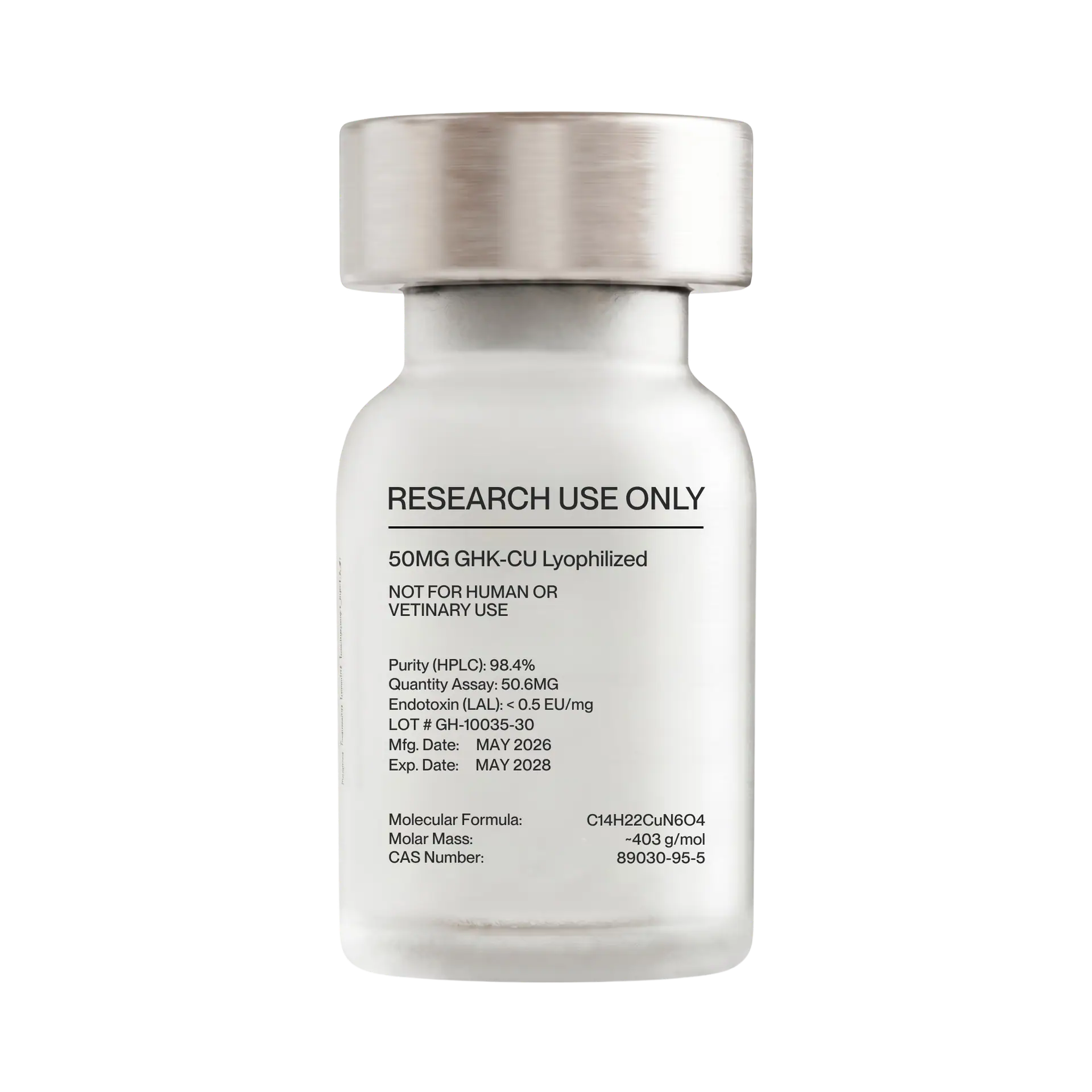
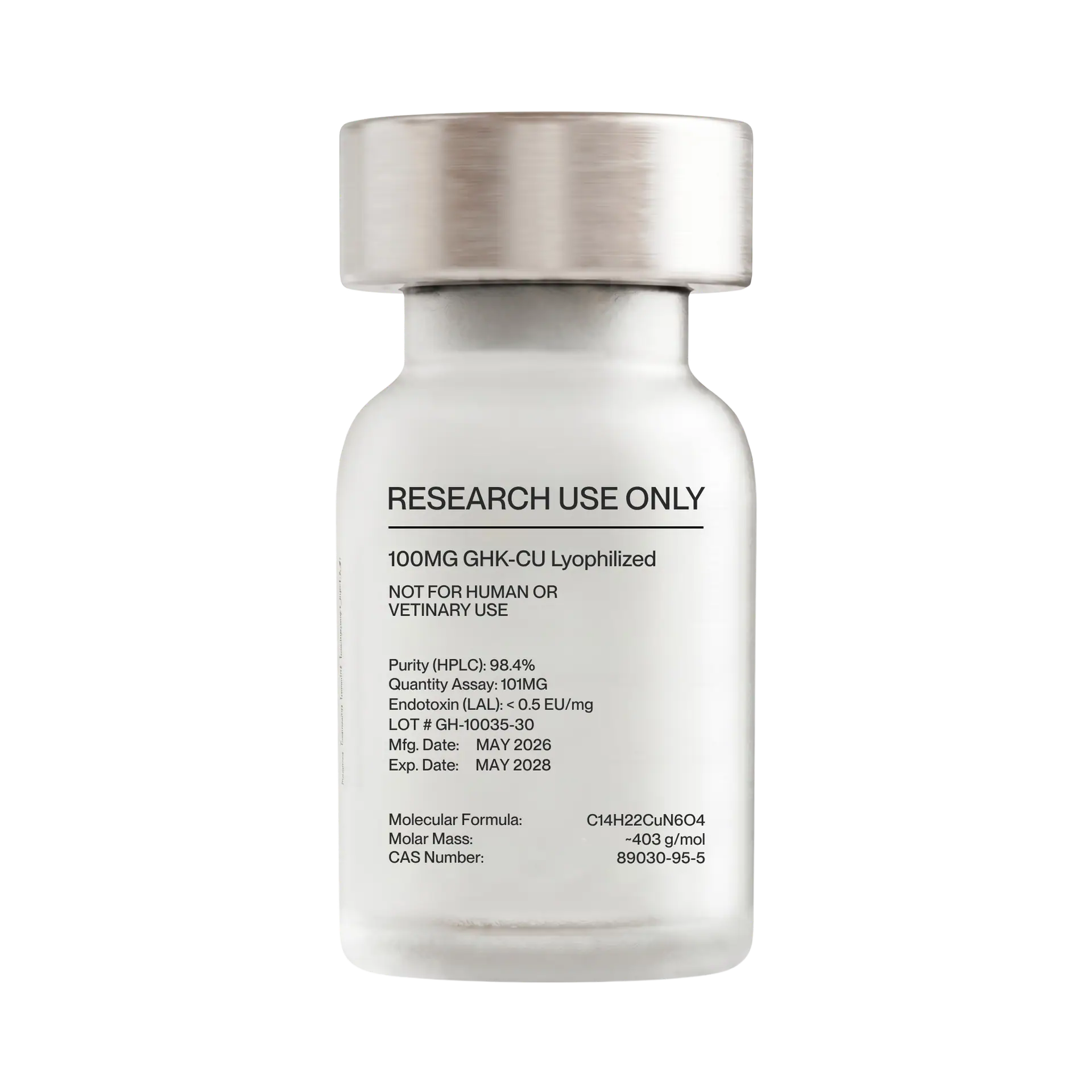
Purity (HPLC)98.4%
CAS number89030-95-5
Molecular formulaC14H22CuN6O4
Molar mass~403 g/mol
Endotoxin (LAL)< 0.5 EU/mg
FormatLyophilized powder
SKUGHKCU-50MG

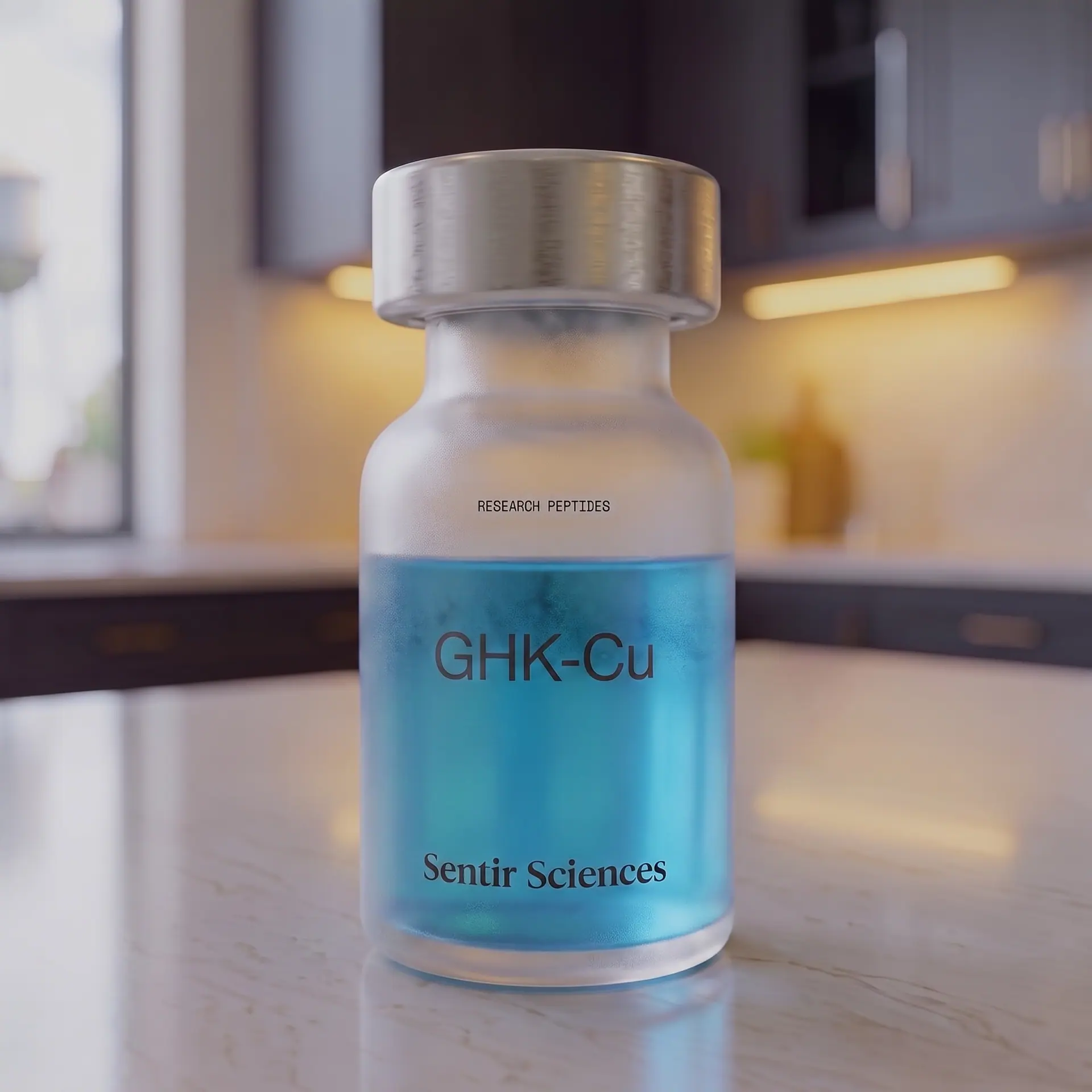
GHK-Cu is a small, naturally occurring peptide bound to a copper ion — the blue tint you'll see in solution is the copper itself. It was first identified in human plasma decades ago and has been studied steadily ever since.

Most of the research around it sits in skin science: collagen production, the structure of the dermal matrix, and how repair-related genes switch on and off. A staple of cosmetic-science and tissue-model work.

Dermal matrixCollagen synthesisGene expression

Keep the sealed vials in the fridge and out of direct light — they’ll hold up for a long time that way. Once a vial is mixed, keep it refrigerated and use it within the window your protocol calls for.

Every batch we sell is tested by an independent U.S. lab before it goes up for sale — that report is the certificate of analysis, and a copy is included with every order. Want the one for your exact vial? Email the lot number printed on the label to [email protected] and we’ll send it over within one business day.

Don’t take our word for it.

Rated 4.9 out of 5 stars on Trustpilot

Rated Excellent — 4.9 out of 5 on Trustpilot

Rated 5 out of 5 stars

I NEVER WRITE REVIEWS

From all my experiences and different companies I've tried, this one just stuck out to me. Best customer service I’ve ever spoken with, extremely fast shipping, got my order in 3 days, great quality and they are extremely consistent with every order I place! I would reccomend Sentir time and time again and I’m super glad I found them.

Brad PPosted on Trustpilot · Aug 2026
Rated 5 out of 5 stars

10/10 experience

10/10 experience! Quality product, their tracking system is extremely useful and transparent, it came in extremely nice packaging and i'm honestly super glad i trusted them with my money, I am now a customer for life!

Dustin PPosted on Trustpilot · Aug 2026
Rated 5 out of 5 stars

I love Sentir Sciences

I’ve been using Sentir since May and they’ve came so far and the business has grown so much, the presentation, customer service, shipping times are really just outstanding. Best prices I’ve seen anywhere too. I love sentir sciences

Dylan MPosted on Trustpilot · Aug 2026
Rated 5 out of 5 stars

Every interaction has been amazing

I’ve been with Sentir Sciences several months now and every interaction with them has been amazing! Their customer service response time is the fastest of any company that I have dealt with online. Delivery time is quick by UPS. I can’t say enough positive things about them and I make no money off of this post

Ian GPosted on Trustpilot · Aug 2026

Frequently asked questions.

No. Everything we sell is strictly for laboratory and research use. Every vial is labeled "research use only — not for human or veterinary use", and you'll be asked to agree to our research-use policy at checkout.
Every batch is sent to an independent U.S. lab before we sell a single vial of it. They measure how pure it actually is and confirm the compound is exactly what the label says. The number you see is the number they measured — we never copy figures from a supplier's paperwork.
Yes, and we'd encourage it. Every vial has a lot number printed on the label. Email that number to [email protected] and we'll send you the full report for your exact batch, charts included, within one business day.
Keep the sealed vials in the fridge and out of direct light — they'll hold up for a long time that way. Once a vial is mixed, keep it refrigerated and use it within the window your protocol calls for.
Orders placed before 2pm ET go out the same business day. Anything after that ships the next morning. Everything is packed in protective, unbranded packaging and you'll get a tracking link by email as soon as it leaves us.
We ship across the United States, and shipping is tracked on every order. You'll see the exact cost at checkout before you pay — no surprises added at the last step.
Email us with your order number and a photo and we'll make it right — a replacement or a refund, whichever you'd rather have. Every order is covered, so you're never stuck with a vial you can't use.
Yes. Orders ship in plain, unbranded packaging with nothing on the outside describing what's inside. Your billing statement simply shows our company name.
Of course. Email [email protected] with any question — about a specific compound, a lab report, or an order in progress — and a real person will get back to you, usually the same day, Monday through Friday.
Compound notes

Also referenced as: copper peptide GHK-Cu · GHK copper complex · glycyl-L-histidyl-L-lysine

What GHK-Cu is.

GHK-Cu is a three-amino-acid peptide — glycine, histidine, lysine — bound to a copper(II) ion. It occurs naturally in human plasma, where it was first isolated in the 1970s; circulating levels are highest in youth and decline steadily with age, an observation that has driven interest in it ever since.

The copper is not a contaminant — it's the point. The peptide's histidine and the free amine chelate the ion into a stable complex, and that complex is the biologically studied form. It's also why a properly reconstituted vial has a distinct blue tint: you are literally looking at the copper.

Where the research points.

The densest literature sits in skin science: collagen and glycosaminoglycan synthesis in fibroblast culture, remodelling of the dermal matrix, and wound-model studies going back decades. GHK-Cu is a fixture of cosmetic-science R&D for exactly this reason.

The more recent and arguably more interesting thread is gene expression. Profiling studies have reported that GHK exposure shifts the expression of a strikingly large number of genes, many associated with tissue remodelling and repair programs — which is why it now appears in studies well outside dermatology, from lung-tissue models to nerve-regeneration work.

On the bench.

Supplied as lyophilized powder in 50 mg and 100 mg vials at 98.4% verified purity. The blue color on reconstitution is expected; a colorless solution of a copper complex would be the red flag. As a small, robust tripeptide it tolerates handling better than long-chain peptides, but the same rules serve it: lyophilized at −20 °C, reconstituted at 2–8 °C.

It pairs naturally with our other recovery-line compounds — many published repair-model designs run a matrix-side arm (GHK-Cu) against a signalling-side arm (BPC-157 or TB-500).

The published record runs deeper than any product page should. For the primary literature, browse GHK-Cu studies on PubMed. For how every batch we sell is verified, see how we test.

From our research library: What “99% pure” actually means. · BPC-157 vs TB-500. · Storing and handling peptides properly.

GHK-Cu — common questions.

No. GHK-Cu is supplied strictly for laboratory research. It is not for human or veterinary use, and every order requires agreement to our research-use policy.

Because of the copper. GHK-Cu is a peptide–copper(II) complex, and dissolved copper complexes are blue — the tint is direct visual confirmation that the ion is present and bound. A colorless GHK-Cu solution would suggest the copper is missing.

GHK is the bare tripeptide; GHK-Cu is that peptide complexed with a copper ion. The copper-bound form is what circulates in plasma and what most of the biological literature describes, so it's the form we supply.

The current batch is 98.4% pure by HPLC, tested by an independent US laboratory before sale — along with identity confirmation and endotoxin screening below 0.5 EU/mg. The certificate of analysis is included with every order, and the report for any specific vial is available by emailing its lot number.

GHK-Cu is available in 50mg and 100mg vials of lyophilized powder. Quantity discounts apply automatically at checkout.

Keep sealed vials frozen at −20 °C and away from light. Once reconstituted, hold the solution at 2–8 °C and use it within the window your laboratory protocol defines.